


Best Juicer Types for Home in Australia: Cold Press vs Centrifugal Juicers Compared
Cold press, twin gear and centrifugal juicers compared on speed, output, noise and cleaning, with seven household juicers from our range in one table and which one fits which need.

For most Australian homes the best type of juicer is a cold press juicer, also called a slow or masticating juicer. It presses produce at 50 to 110 RPM instead of spinning it at about 3,000 RPM, and it handles leafy greens and celery as well as fruit. A centrifugal juicer is the fast type and suits anyone making a lot of juice in a hurry, which is why the centrifugal juicers we sell are commercial machines for cafes and juice bars.
Below is how each type works, a table of the household juicers we sell, and which one fits which need. All figures are each maker's own, as listed on our product pages.
What are the main types of juicer?
- Cold press, single auger. One screw-shaped auger turns slowly and presses the produce against a strainer. The Kuvings juicers in our range are this type: upright machines that run at 50 RPM. Kuvings calls them whole slow juicers.
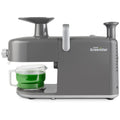
- Cold press, twin gear. Two stainless steel gears turn against each other to crush, mix and press the produce. Greenstar juicers are this type: horizontal machines that run at 100 to 110 RPM.
- Centrifugal. A grating disc shreds the produce and a basket spinning at about 3,000 RPM throws the juice out through a filter. The pulp is ejected automatically, so the machine keeps going.
There are also citrus juicers, made for oranges and lemons only, and manual juicers such as the hand-cranked Z Star Z-710, which needs no power at all.
Cold press vs centrifugal: what is the difference?
| What you are comparing | Cold press (slow) juicer | Centrifugal juicer |
|---|---|---|
| How it works | An auger or twin gears press the produce slowly | A grating disc and a fast-spinning basket |
| Speed | 50 RPM (Kuvings) to 110 RPM (Greenstar Elite) | 3,000 RPM (Santos #50CX, Robot Coupe J80) |
| Output | 40 litres an hour for the commercial Kuvings CS600 | More than 100 litres an hour for the Santos #50CX and 120 litres an hour for the Robot Coupe J80 |
| What it juices | Fruit, hard vegetables and greens. Greenstar lists celery, root vegetables, ginger and wheatgrass | Santos lists whole apples, carrots and tomatoes. Ceado's heavy duty model lists leafy vegetables too |
| Noise | Kuvings lists a brushless motor for quiet operation | Santos lists 65 dBA for the #50CX |
| Run time | 30 minutes to 1 hour of continuous use for the home models below | Built for continuous juice production |
| In our range | Household and commercial models | Commercial models only |
Which type of juicer gets the most juice?
Slow juicer makers build their case on yield. Kuvings says its low-speed masticating design gives a higher juice yield. Greenstar says its twin gears add a mixing stage between crushing and pressing for higher yields, and cites a test by Anamol Laboratories in which the Greenstar produced the most juice of the juicers tested, including over 30% more than single auger juicers. Those are the makers' claims. On our own product page we call the Greenstar the best juicer we have used for hard vegetables and greens, including celery, which clogs many juicers.
A centrifugal juicer wins on speed instead. Robot Coupe lists the J80 at one glass of fresh juice every 7 seconds, and Ceado lists its heavy duty juicer at two litres in a minute. That matters behind a counter. It matters much less for a few glasses at breakfast.
Which juicer is quietest and easiest to use?
A slow juicer has no fast-spinning basket, and Kuvings lists quiet operation for its home models. How much work the juicer asks of you depends more on the feeding chute than on the type:
- Wide chute. The Kuvings EVO820 has an 82 mm chute to cut down on chopping, and a flip gate that Kuvings says suits people with less strength in the wrist.
- Two chutes. The Kuvings REVO830 adds a 45 mm chute made for celery and carrots beside the 82 mm one.
- Hopper. The Kuvings AUTO10 has a 3 litre hopper: load whole produce, switch it on and walk away.
- Twin gear. A Greenstar needs some downward pressure to push produce into the gears. We don't recommend it for anyone with arthritis or weakness in the arms.
How hard are juicers to clean?
Every juicer has to be rinsed after use, so look at what the maker gives you to do it. Kuvings includes a cleaning tool for the strainer and a smart cap you can close to run a rinse through the bowl. The Greenstar 5 has a housing you remove and rinse, an integrated drip tray and a scraper tool for the screen. On the centrifugal side, the Santos #50CX has a bowl, basket and cover that come off without tools.
Household juicers compared
| Model | Type | Speed | Motor | Feeding | Continuous use | Weight | Maker's warranty |
|---|---|---|---|---|---|---|---|
| Kuvings EVO820 | Vertical slow juicer | 50 RPM | 240 W | 82 mm chute | 30 minutes | 7.1 kg | 20 years motor, 5 years parts |
| Kuvings REVO830 | Vertical slow juicer | 50 RPM | 200 W | 82 mm and 45 mm chutes | 1 hour | 7.5 kg | 20 years motor, 5 years parts |
| Kuvings AUTO10 | Vertical slow juicer | 50 RPM | 200 W | 3 litre hopper | 30 minutes | 7.5 kg | 20 years motor, 5 years parts |
| Kuvings C8000 | Vertical slow juicer | 50 RPM | 248 W | Wide chute | 45 minutes | 6.4 kg | 20 years motor, 5 years parts (domestic use) |
| Greenstar 5 | Horizontal twin gear | 100 RPM at 50 Hz | 200 W | Tamper | 40 minutes | 8.85 kg | 15 years motor, 5 years parts (household) |
| Greenstar Elite | Horizontal twin gear | 110 RPM | 200 W | Plunger | Not listed | 12.25 kg | 12 years motor, 5 years parts and labour (domestic) |
| Z Star Z-710 | Manual single auger | Hand crank | None | By hand | Not listed | Not listed | 1 year |
Every household juicer we sell is a cold press juicer. See them all under cold press juicers, or browse the full juicers range.
Which juicer fits which need?
- Mostly greens, celery, wheatgrass and hard vegetables: a twin gear Greenstar juicer. With its homogenising accessories it also makes nut butters and sorbets.
- Celery and carrot juice most days: the Kuvings REVO830, with its own chute for both. See our celery juicers.
- Short on time: the Kuvings AUTO10 and its hopper.
- Whole fruit with little chopping: the Kuvings EVO820.
- Camping, travel or a daily wheatgrass shot: the manual Z Star Z-710.
- A lot of juice, fast, for customers: a centrifugal machine from our commercial juicers.
Do you need a centrifugal juicer at home?
Usually not. The centrifugal juicers we sell are built for business. Ceado's medium duty centrifugal juicer weighs 17 kg and is made for juice bars that use up to 10 kg of fruit a day. If you juice for a household, a slow juicer does the job, takes greens and celery in its stride, and comes with a long motor warranty for home use.
Frequently asked questions
What is the best type of juicer for home use? A cold press juicer suits most homes. It presses slowly, takes greens and celery as well as fruit, and the home models in our table carry motor warranties of 12 to 20 years.
Is a slow juicer the same as a cold press juicer? Yes. Slow juicer, masticating juicer and cold press juicer are names for the same type: a machine that presses produce at low speed. Twin gear juicers are cold press juicers too.
Which juicer is best for celery and leafy greens? A twin gear Greenstar is made for them: its gears have cutting points for stringy vegetables like celery. In a single auger juicer, the Kuvings REVO830 has a chute made for celery and carrots.
Is a centrifugal juicer faster than a cold press juicer? Yes. The Robot Coupe J80 centrifugal juicer lists 120 litres an hour, while the commercial Kuvings CS600 cold press juicer lists 40 litres an hour.
How long can a home cold press juicer run? It depends on the model. The makers list 30 minutes of continuous use for the Kuvings EVO820 and AUTO10, 40 minutes for the Greenstar 5, 45 minutes for the Kuvings C8000 and 1 hour for the Kuvings REVO830.
What warranty does a home juicer come with? Kuvings lists 20 years on the motor and 5 years on parts. Greenstar lists 15 years on the motor for the Greenstar 5 and 12 years for the Greenstar Elite, each with 5 years on parts. The manual Z Star has a 1 year warranty.
Sources: each model's type, speed, power, run time, weight and warranty as listed by its maker on our product pages.
More from the blog

Buying guide
Cold Press Juicer Buying Guide: Home vs Cafe and Commercial Models Compared
Nine cold press juicers from our range, four for home and five for cafes and juice bars, compared on speed, chute, run time, output, cleaning and the maker's warranty.

Buying guide
Which Vitamix Should I Buy? Ascent vs Explorian vs Commercial Models Compared
The Vitamix Explorian E310, the three Ascent models and five commercial Vitamix blenders compared on container size, programs, motor, size and warranty, with which one suits a home, a cafe or a kitchen.

Exciting News: The Greenstar 5 Has Arrived, and I Couldn’t Be More Thrilled!
G’day everyone, Tommy here from Raw Blend, and I’m beyond excited to share some fantastic news with you – we’re the exclusive distributors of Greenstar products in Australia, and now we’re introducing the all-new Greenstar 5! As someone who’s been…


 In this storyGreenstar 5 All-Stainless Steel Twin Gear Cold Press Masticating Juicer (Slate)
$1,495